
Wildflowers illustration © Jacquie Macintyre
Marielle Barclay was a supporter of the Newtonmore Community Woodland Development Trust. Marielle loved the outdoors, the trees and in particular the many varied and rare wildflowers that grew around Newtonmore. The panels you will see around the village have been funded by her bequest and hopefully will assist visitors and locals to identify the flowers. Please do not pick the flowers so they can remain for others to enjoy.
Please take care
The fragile and special landscape in areas where you will find wildflowers needs your help!
To help us protect it please follow the outdoor access code and follow these main principles
when walking near any of the wildflower sites.
- Respect the environment and leave no trace.
- Please keep to the path.
- Do not pick any wildflowers you may see.

Use the buttons below to ‘jump’ quickly to the relevant panel.
Panel 1
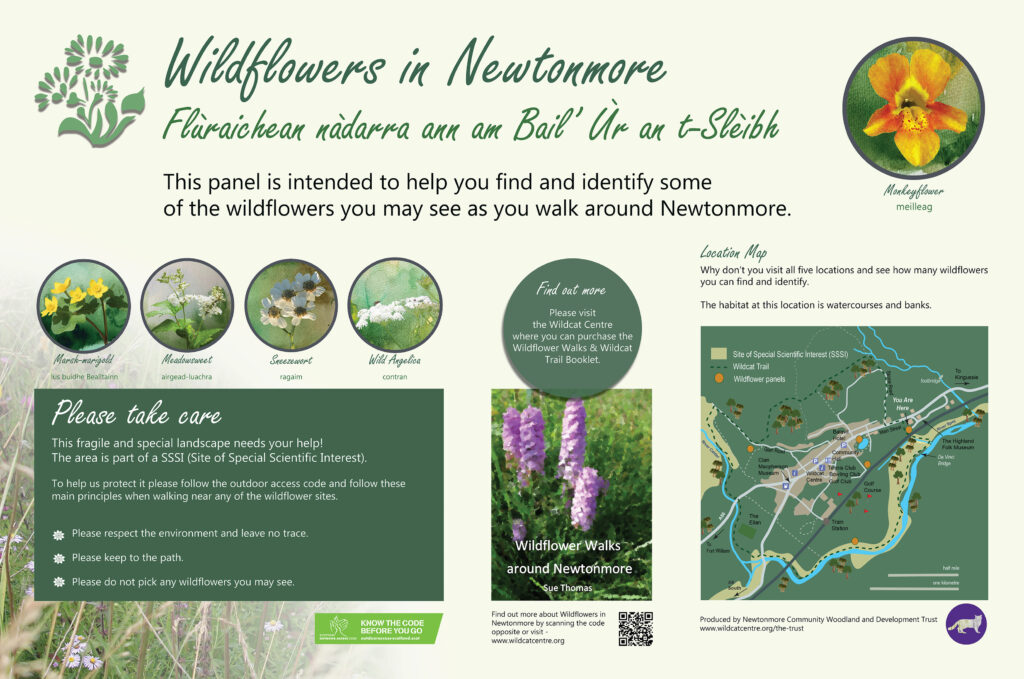
Approaching the golf course from the main street just before the Highland Folk Museum.
The habitat at this location is watercourses and banks.
All the flowers here thrive in damp conditions, including Monkeyflower and Marsh-marigold, which grow in water. Meadowsweet has honey scented flowers that can be used like Elderflower to make a drink. Sneezewort was used in the past in a dried powder to induce sneezing, which they thought was beneficial! Wild Angelica is very similar to the edible Angelica whose stems are candied. Some of the flowers you may see include –

Marsh-marigold (Caltha palustris)
© Jacquie Macintyre

Meadowsweet (Filipendula ulmaria)
© Jacquie Macintyre

Sneezewort (Achillea ptarmica)
© Jacquie Macintyre

Wild Angelica (Angelica sylvestris)
© Sue Thomas

Monkeyflower (Mimulus agg.)
© Jacquie Macintyre
Panel 2
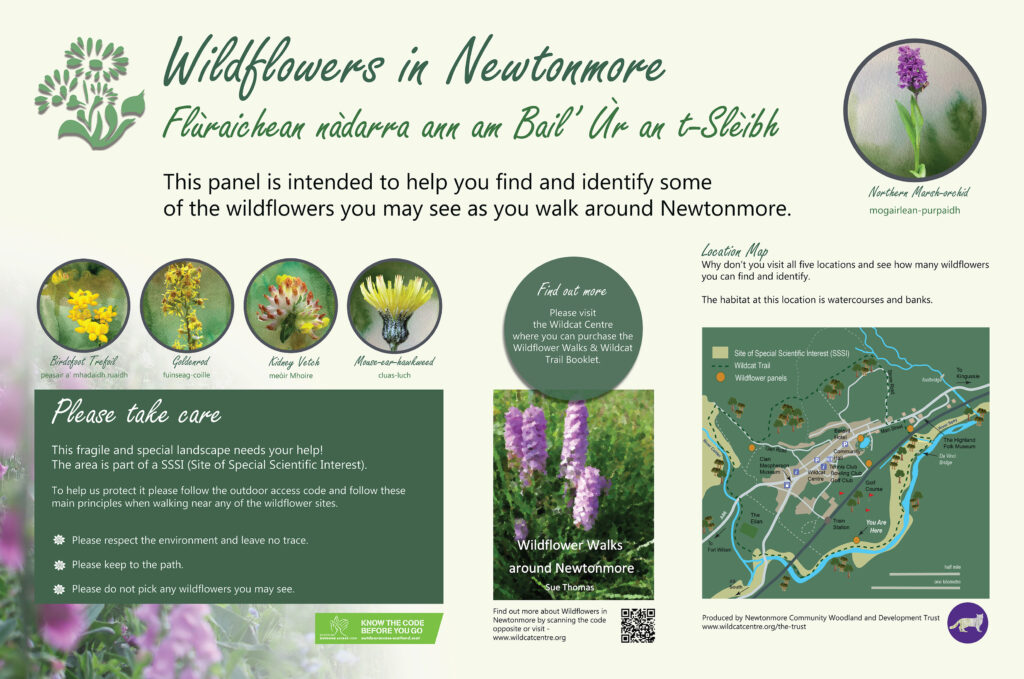
End of the Golf Course by the Spey.
The habitat at this location is watercourses and banks.
Bird’s-foot-trefoil has seed pods that look like a bird’s foot and can be seen growing alongside paths. Kidney Vetch is essential as a food plant for the caterpillars of the Small Blue butterfly which eat the flowers and the seeds. Some of the flowers you may see include –

Bird’s-foot-trefoil (Lotus corniculatus)
© Jacquie Macintyre

Goldenrod (Solidago virgaurea)
© Jacquie Macintyre

Kidney Vetch (Anthyllis vulneraria)
© Sue Thomas

Mouse-ear Hawkweed (Pilosella officinarum
© Jacquie Macintyre)

Northern Marsh Orchid (Dactylorhiza purpurea)
© Jacquie Macintyre
Panel 3
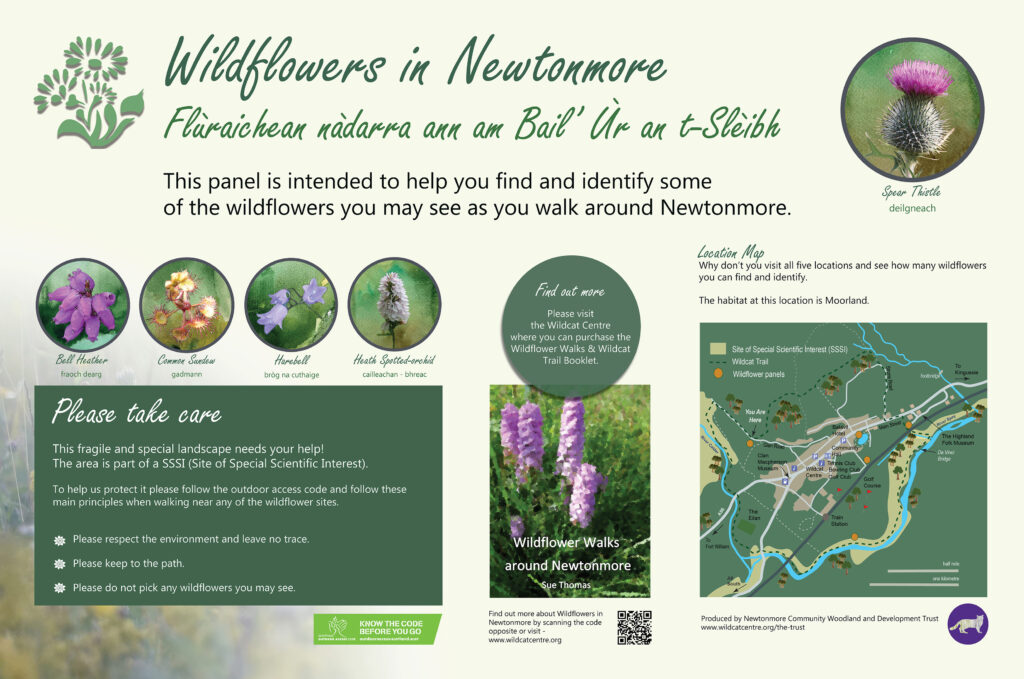
Glen Banchor at the top of Glen Road
The habitat at this location is moorland.
This area of moorland has three kinds of heather. Bell Heather flowers first and is a bright pink, and later the hills are clothed with the pale purple heather (Calluna vulgaris). A third heather called Cross-leaved Heath grows in damp places where you will also find the Common Sundew. There are few nutrients in wet places, so the Sundew catches insects on its sticky leaves to gain some nourishment. Another insectivorous plant of damp places is Common Butterwort. Some of the flowers you may see include –

Bell Heather (Erica cinerea)
© Jacquie Macintyre

Common Sundew (Drosera rotundifolia)
© Jacquie Macintyre

Harebell (Campanula rotundifolia)
© Jacquie Macintyre

Heath Spotted Orchid (Dactylorhiza maculata)
© Jacquie Macintyre

Spear Thistle (Cirsium vulgare)
© Jacquie Macintyre

Common Butterwort (Pinguicula vulgaris)
© Sue Thomas
Panel 4
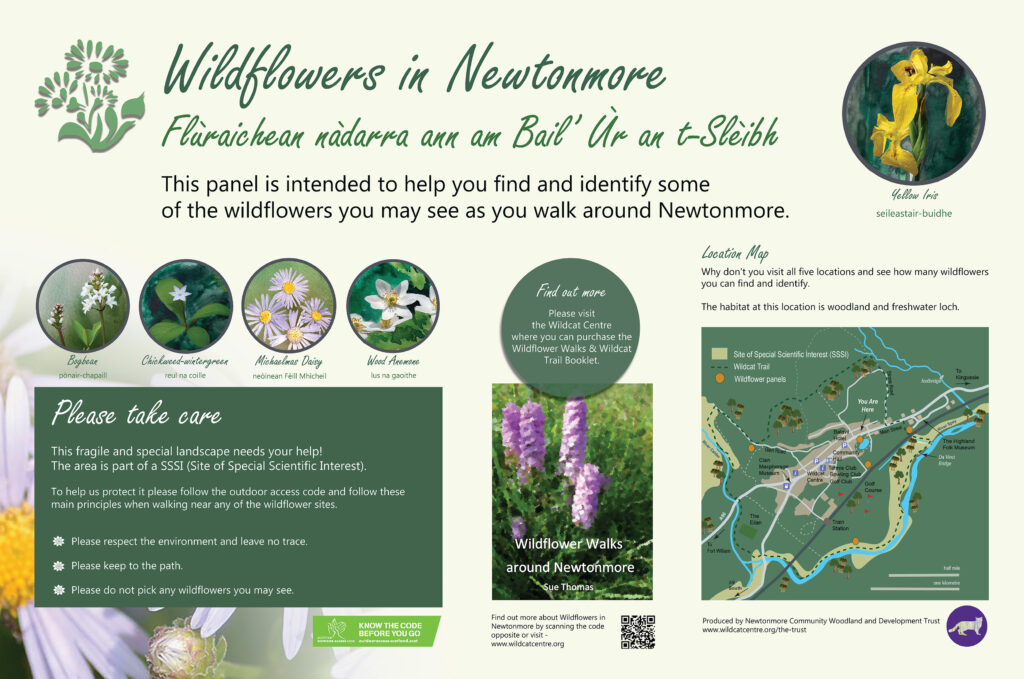
Loch Imrich
The habitat here is woodland and freshwater loch.
The Wood Anemone is the first plant to flower in Spring on the slopes under the bare trees and it is followed by the Chickweed-wintergreen. The fluffy pink flowers of the Bogbean and the Yellow Iris grow in the water, and in Autumn the Michaelmas Daisies flower on the banks. Some of the flowers you may see include –

Bogbean (Menyanthes trifoliata)
© Sue Thomas

Chickweed-wintergreen (Trientalis europaea)
© Jacquie Macintyre

Michaelmas Daisy (Aster novi-belgii)
© Jacquie Macintyre

Wood Anemone (Anemone nemorosa)
© Jacquie Macintyre

Yellow Iris (Iris pseudacorus)
© Jacquie Macintyre
Panel 5
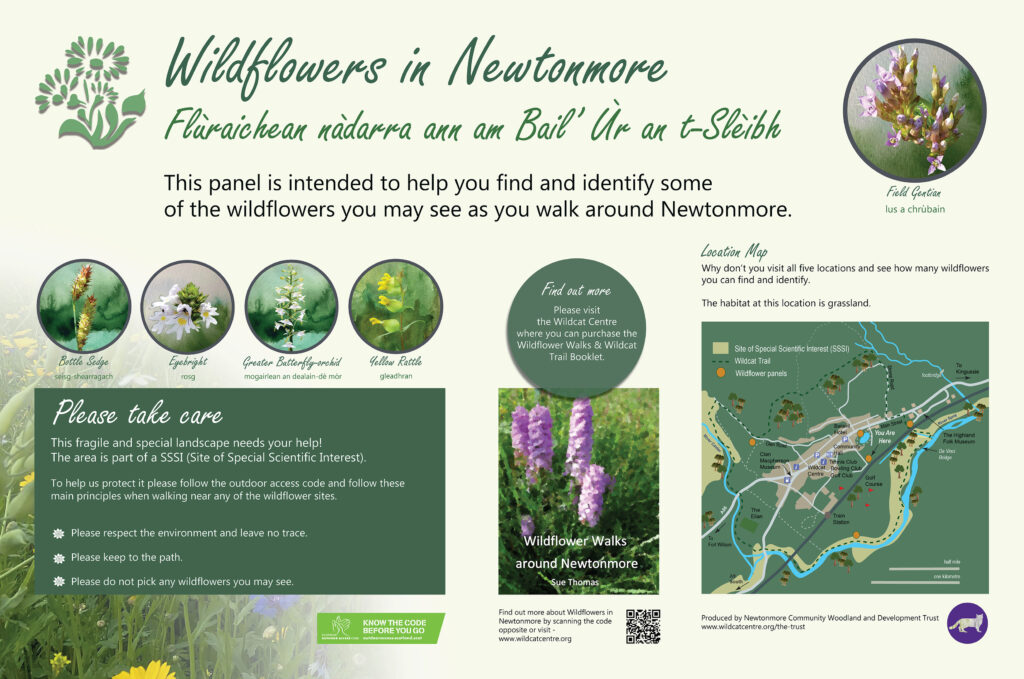
By the Railway Bridge
The best place to see the Greater Butterfly Orchids is alongside the Spey, but there are also many growing in the rough areas of the Lower Golf Course by the railway bridge. They flower in late June and into July. Yellow Rattle grows in the same area and is parasitic on grass roots. This reduces the competition, allowing the orchids to thrive. When the orchids have finished flowering, they are followed by the blue flowers of Devils-bit Scabious. Some of the flowers you may see include –

Bottle Sedge (Carex rostrata)
© Jacquie Macintyre

Eyesbright (Euphrasia egg.)
© Jacquie Macintyre

Greater Butterfly Orchid (Platanthera chlorantha)
© Jacquie Macintyre

Yellow Rattle (Rhinanthus minor )
© Jacquie Macintyre

Devils-bit Scabious (Succisa pratensis)
© Sue Thomas
For more information on exactly where you can see these flowers and many more, you can purchase a book “Wildflower Walks around Newtonmore by Sue Thomas” at the Wildcat Centre.

If you do not have your own wildflower field guide, there is an excellent free downloadable book by Alan R Walker that covers many of the local flowers. It is available here: